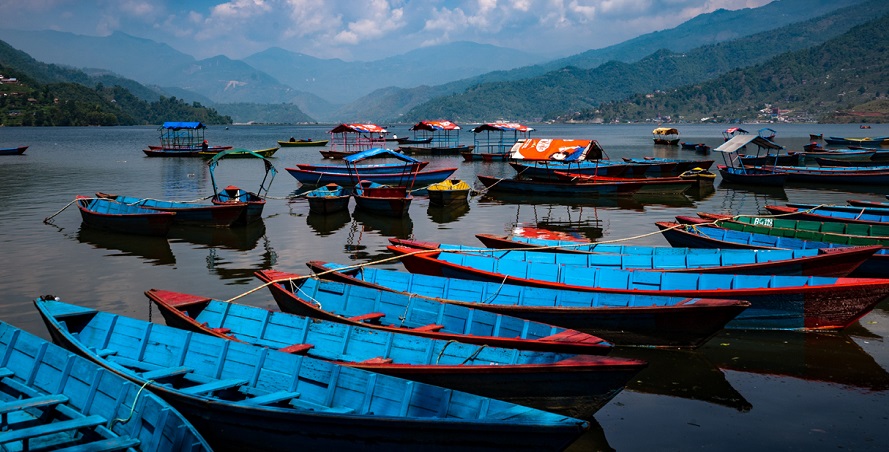
Himal Hub / Residents around Phewa Lake were startled early Saturday by the noise of excavators as authorities began tearing down structures built on lake land. After heavy rainfall the previous night, Pokhara woke to machinery rumbling along the lakeshore. At the Waterfront Resort, tourists looked out to see an excavator digging through the property’s swimming pool, turning its clear blue water muddy.
The Pokhara Metropolitan City launched the operation to enforce a Supreme Court order, demolishing 32 structures deemed illegal within the lake’s boundary. The move was carried out under the direction of Prime Minister Balendra Shah and in coordination with the Ministry of Home Affairs. Around 150 security personnel, including Nepal Police, Armed Police Force, district police, and municipal police, were deployed.
City officials said the demolition targeted buildings constructed inside the officially designated boundary of Phewa Lake. Mayor Dhanraj Acharya stated that authorities had issued multiple notices beforehand and that the action followed instructions from the home ministry.
The crackdown stems from a Supreme Court verdict issued on June 20, 2023, with its full text released in September the same year. The ruling requires a 65-metre buffer zone around the lake to be preserved as a green area and orders the removal of all unauthorised structures within six months.
The court also ruled that land registered after the 1976 survey is invalid, interpreting the Land Revenue Act 1977 to mean that any private ownership of public land is void. As a result, no compensation will be provided for such plots. Compensation applies only to those who held legitimate ownership before 1976 and have consistently paid taxes.
To implement the ruling, a facilitation committee was formed in November 2023 under Gandaki Province Chief Minister Surendra Raj Pandey. A technical team used DGPS technology and drone surveys to redefine the lake’s boundary, recently estimating its area at 6.343 square kilometres—larger than previously recorded.
Earlier this year, the city issued a 15-day notice asking owners to remove illegal structures or face demolition at their own cost. Despite repeated warnings, most structures remained.
Following the inclusion of Phewa Lake conservation in the government’s reform agenda, Prime Minister Shah sought updates from the mayor in late March. Within a week, demolition began under heavy security, despite protests from local residents.
Critics, including Nabin Baral of the Phewa Lake Victims’ Concern Committee, condemned the operation as excessive and disruptive, especially in a major tourist area. He argued that demolitions without compensation were unjust. However, Mayor Acharya maintained that structures built illegally within the restricted zone would not be compensated, though legal landowners would receive compensation through a separate process.
The current situation has roots in historical changes to the lake. A dam built in 1961 altered water levels, and a 1974 dam failure exposed lakebed areas that were later registered as private land during the 1976 survey. When water levels rose again, many of these plots were submerged.
Efforts to regulate the lake date back to 1973, when construction within 200 feet of the shoreline was banned. Over time, encroachment increased, leading to legal battles. A 2012 government report found that 1,692 ropanis of lake land had been illegally registered.
In 2018, the Supreme Court ordered the government to define the lake’s boundaries and remove encroachments, but delays led to further legal action. A final ruling in 2023 reaffirmed that land registered after 1976 is fraudulent and must be returned to the state without compensation.