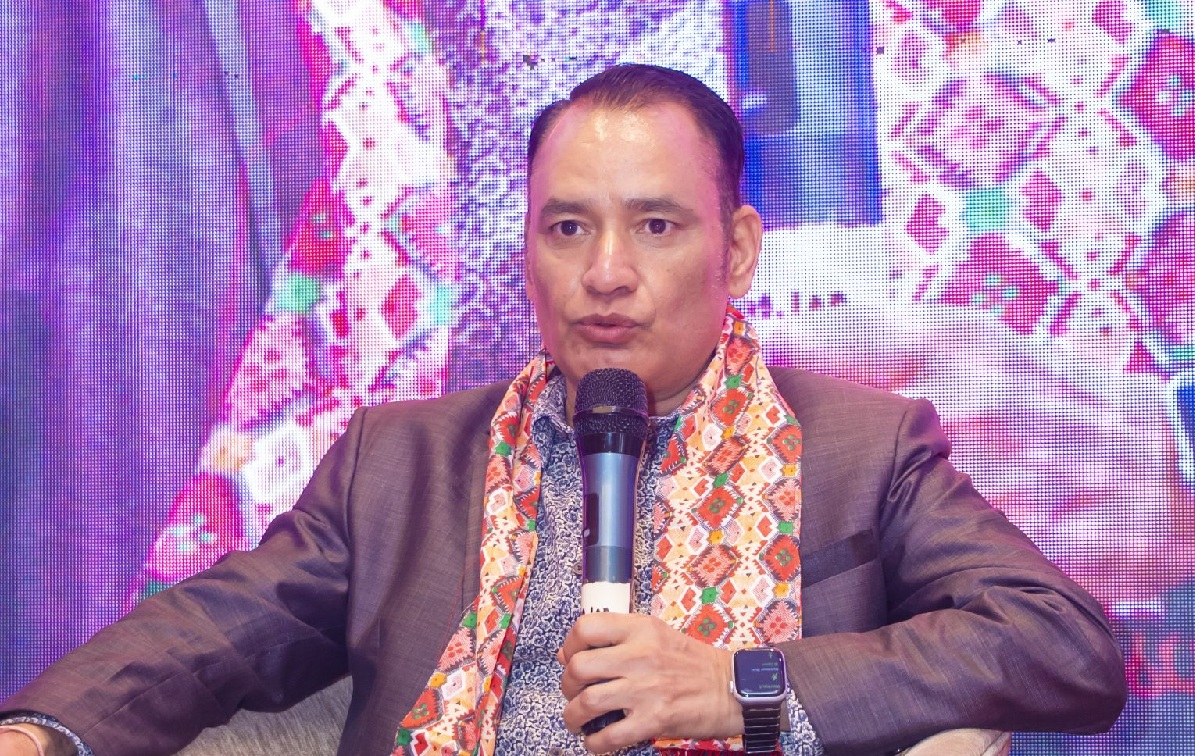
Himal Hub / Senior economist and banking expert Nar Bahadur Thapa has said that Nepal has not yet reached the stage of fully utilizing artificial intelligence (AI). Speaking at the ‘AI and Digitalization Summit 2026’ organized by Media International, he stated that although the potential of AI is enormous, it has not yet reached a stage where it can immediately bring significant growth to the country’s economy.
Addressing the program on AI and digitalization, Thapa said AI should be viewed not as a direct tool for economic development but as a technology that enhances efficiency, speed, and effectiveness in various tasks. According to him, AI can make important contributions to increasing productivity, improving decision-making processes, and strengthening service delivery across different sectors.
He said that digitalization in Nepal’s financial sector has expanded significantly in recent years. Banks and financial institutions have modernized service delivery through computer automation, digital payment systems, mobile banking, and online services. However, he emphasized that the next priority should be advancing the use of digital technology to a higher level and utilizing AI to provide a new direction for the economy.
According to Thapa, the application of AI should not remain limited to the private sector but should also be expanded into public administration, financial policymaking, and government service delivery. He stressed that Nepal Rastra Bank, government agencies, and public institutions should increase the use of AI to develop data-based decision-making systems.
He said AI can play an important role in improving the quality and expansion of services in sectors such as education, healthcare, insurance, and finance. In education, AI can support the development of personalized learning systems; in healthcare, it can assist in disease detection and treatment management; in insurance, it can improve risk assessment and claims management; and in the financial sector, it can enhance customer services and risk management.
Thapa noted that developed countries around the world are widely using AI for economic development, increasing production, and modernizing service sectors, and Nepal should learn from these practices. He said AI should not be viewed merely as a technological issue but as a strategic tool for national development.
During the program, Thapa also welcomed the plans to establish data hubs and data centers in Nepal. He expressed the belief that developing modern data infrastructure would accelerate the growth of the digital economy and create the necessary foundation for operating AI systems. According to him, such infrastructure would make digital services provided by both government and private sectors more secure, reliable, and efficient.
Thapa emphasized that AI should be used not as a replacement for human labor but as a tool to enhance human capabilities. He concluded that with appropriate policies, infrastructure, and investment, Nepal can enter a new era of the digital economy and build a strong foundation for achieving long-term economic development goals.
He further stated that the use of AI would be more beneficial for policymakers and decision-makers rather than only for ordinary citizens’ daily activities. According to him, AI can become an effective tool for decision-makers by helping them make faster and better-quality decisions based on facts, data, and analysis.
He said that the government, regulatory bodies, banks and financial institutions, business leaders, and policymakers can use AI to improve long-term planning, risk assessment, and strategic decision-making processes.