Himal Hub. A political exchange over the nature and functioning of the government led by Prime Minister Balendra Shah took place in the House of Representatives on Thursday, with lawmakers from the opposition CPN-UML and ruling Rastriya Swatantra Party (RSP) offering sharply different descriptions.
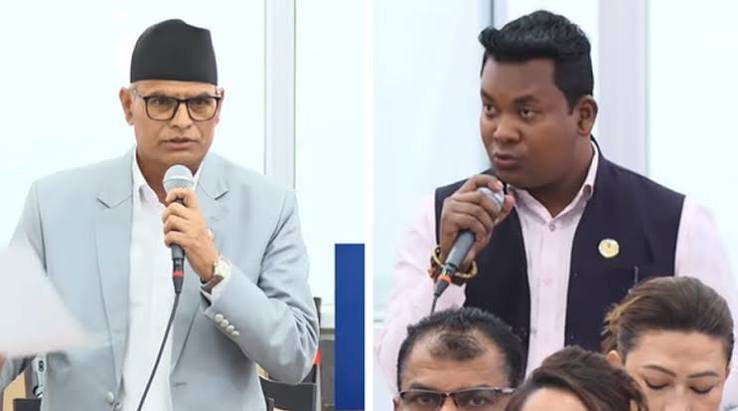
During the parliamentary meeting, UML lawmaker Laxmi Prasad Pokhrel questioned what kind of government the country is currently being governed by. He said the government could be viewed as constitutional because the prime minister is the leader of a parliamentary party that commands a majority in the House.
At the same time, Pokhrel raised questions about the government’s political functioning, pointing to Prime Minister Shah’s absence from meetings of his own party and the government’s approach to broader political consultations.
He also compared the government with different forms of political rule, arguing that its conduct could give the impression of a government operating without sufficient engagement with political parties and institutions. He subsequently asked what the government led by Shah should actually be called.
Responding to the remarks, RSP lawmaker Santosh Rajbanshi defended the government and described its formation as a departure from Nepal’s established political pattern.
Rajbanshi said the election held on February 21, 2026, should not be viewed simply as another election continuing the country’s previous political cycle. According to him, the election represented a political shift that brought a new government to power.
He further argued that the Shah-led government has received a mandate from voters and enjoys a majority in Parliament.
Responding directly to the question about the nature of the government, Rajbanshi said its focus was on reducing corruption. He claimed that the government would take action against mechanisms or institutions involved in weakening the country, regardless of whether they were associated with the judiciary, bureaucracy or political system.
“The government listens to everyone and takes action against those involved in wrongdoing,” Rajbanshi said while describing the government’s approach.
He also said the government was not operating merely to maintain established political practices. According to him, action would continue against individuals and institutions accused of corruption in the past.
The exchange reflects the contrasting positions of the opposition and ruling lawmakers over the government’s political character, institutional approach and stated anti-corruption agenda.