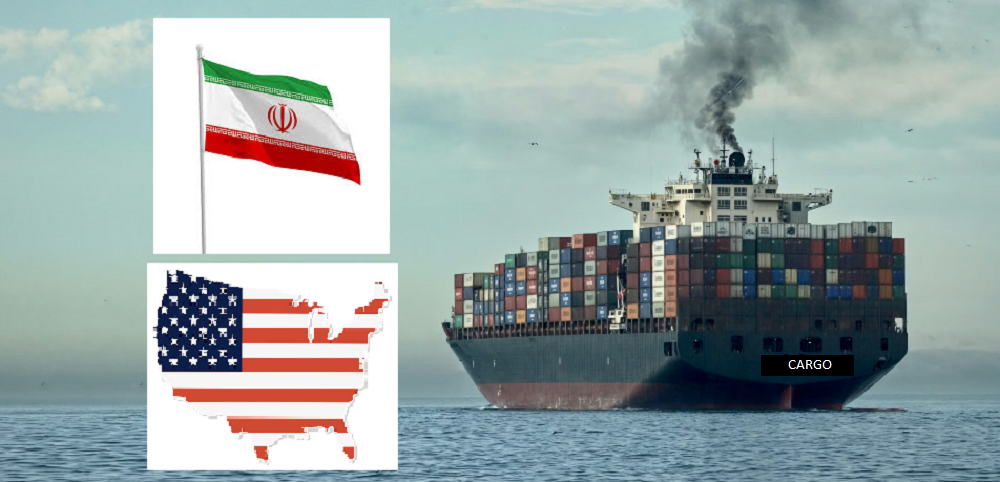
Himal Hub / The highly sensitive fuel transit route, the Strait of Hormuz, has once again become a center of tension. Iran has announced that it is re-closing the waterway and warned that no vessels will be allowed to pass until U.S. sanctions are lifted.
In a statement released Saturday, the naval wing of Iran’s Islamic Revolutionary Guard Corps (IRGC) warned that any ship attempting to pass through the Strait of Hormuz would be “targeted.” Iran also made it clear that vessels heading toward Hormuz from the Persian Gulf and the Gulf of Oman would be considered as cooperating with the enemy.
During talks mediated by Pakistan between U.S. and Iranian representatives, Iran had agreed to reopen the Strait of Hormuz. However, shortly afterward, U.S. President Donald Trump stated that sanctions on Iran would remain in place. He also claimed that an agreement had been reached to transfer Iran’s uranium to the United States.
Iran dismissed Trump’s claim as false and insisted that sanctions must be lifted.
Tensions escalated again less than 24 hours after Iran announced the waterway would be temporarily open and safe for all commercial vessels following the agreement. The news of the agreement had briefly lowered global crude oil prices.
Iranian Parliament Speaker and negotiator Mohammad Bagher Ghalibaf stated in a television interview that the Strait of Hormuz is “under the control of the Islamic Republic.” He criticized the U.S. naval blockade as an “immature and ignorant decision.”
Meanwhile, President Trump warned that Iran cannot “blackmail” by closing the waterway. He said that if no agreement is reached within the set timeframe, the ceasefire would end and U.S. sanctions would continue. Trump also threatened renewed bombing of Iran if no major deal is reached by Wednesday.
According to the United Kingdom Maritime Trade Operations (UKMTO), Iran opened fire on two Indian commercial vessels on Saturday. India’s Ministry of External Affairs also confirmed that two Indian-flagged ships were involved in a “firing incident.”
Other vessels in the area reportedly received radio warnings from the IRGC Navy stating that no ships would be allowed to enter the strait.
Analysts say the situation now resembles “two competing blockades”—on one side, the U.S. blockade on Iranian ports, and on the other, Iran’s move to shut down the Strait of Hormuz.
According to correspondents from Al Jazeera, Iran appears to be using the Strait of Hormuz as a strategic tool for pressure and signaling. As negotiations become increasingly uncertain, Iran’s closure of the waterway is seen as a demonstration of its influence.
Rising tensions in the Strait of Hormuz—one of the world’s most crucial oil supply routes—have heightened concerns about direct impacts on global markets, particularly energy supplies.