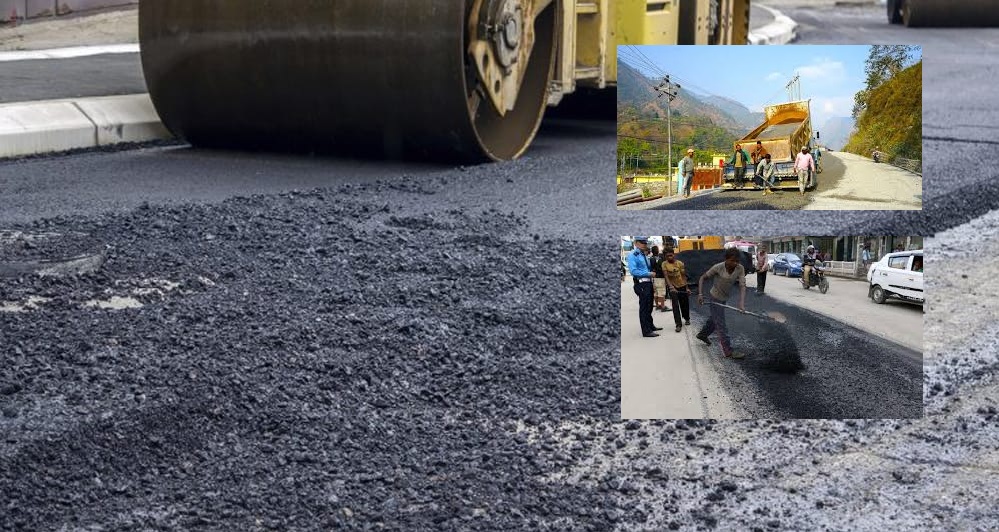
Himal Hub / The recent surge in global fuel prices has directly impacted Nepal’s construction sector, bringing infrastructure projects especially road paving to a near standstill.
Construction of physical infrastructure heavily relies on diesel, kerosene, and bitumen. Due to ongoing geopolitical tensions involving the United States, Israel, and Iran, production sites have faced attacks, leading to reduced output. This, in turn, has driven up the prices of fuel and petrochemicals, along with increased shipping costs and marine insurance premiums—creating a cascading effect on Nepal’s construction industry.
According to Nicholas Pandey, President of the Federation of Contractors’ Associations of Nepal, overall construction costs in the infrastructure sector have risen by up to 40 percent, while road construction costs have surged by as much as 70 percent. He warned that the sector is facing a serious crisis due to both rising costs and shortages of key raw materials.
“Due to international geopolitical factors, the prices of diesel and bitumen have skyrocketed, increasing project costs by 40 to 70 percent,” Pandey said. “With rising prices and material shortages, contractors are uncertain about how to proceed.”
As a result, blacktopping works across the country have largely come to a halt. Projects that depend heavily on bitumen, kerosene, and diesel have been especially affected. The prices of cement and steel rods have also increased, while transportation costs have surged, further driving up expenses.
Major highway projects including the Suryabinayak–Dhulikhel road, Nagdhunga–Naubise section, Mid-Hill Highway, Hulaki Highway, and the expansion of the East-West (Mahendra) Highway—have all been impacted. Maintenance and repair works involving road resurfacing have also slowed significantly.
Contractors report that bitumen is not only expensive but increasingly unavailable in the market. With diesel and kerosene prices rising abnormally, many builders have stated they will not resume work unless the government adjusts contract prices.
Pandey added that the situation has worsened due to the closure of mines and crusher industries in several districts at critical construction periods. Currently, more than 50 percent of infrastructure contracts nationwide most of them road-related have been affected.
“If the government does not adjust prices, contractors cannot continue work,” Pandey said, warning that the crisis could significantly impact Nepal’s development budget and infrastructure progress.
Former Federation President Ravi Singh also noted that construction costs have increased by around 50 percent. He said the severe shortage of bitumen and sharp price hikes have pushed road projects to a halt.
“Bitumen that used to cost Rs 85–90 per kg has now risen to around Rs 135,” Singh said. “Due to rising costs of bitumen, diesel, kerosene, lubricants, cement, and steel, overall construction costs have increased by at least 40 to 50 percent.”
He added that contractors could face losses of up to Rs 4 million on projects worth Rs 10 million under current conditions. Nepal requires approximately 10 to 20 million liters of bitumen monthly for road construction.
Amid growing complaints from contractors, the Ministry of Physical Infrastructure and Transport has acknowledged the issue. Joint Secretary Sushil Babu Dhakal said the ministry is aware of the impact of rising fuel and bitumen prices and has begun internal preparations to address the problem.
“As the ministry responsible for infrastructure development and capital expenditure, we are sensitive to this issue and are exploring solutions,” Dhakal said. He noted that while price adjustment falls under the jurisdiction of the Public Procurement Monitoring Office, the ministry is actively working on possible measures.
Under current procurement laws, contractors must bear up to 10 percent of cost increases. However, the government is now studying whether to revise this limit or introduce relief measures.
A committee led by Dhakal has been formed to assess how to adjust project costs affected by rising prices and supply disruptions.
According to the Department of Roads, the continuous rise in global petroleum and bitumen prices, along with supply constraints, has affected road projects ranging from small local roads to national pride projects.
Contractors have demanded easier access to construction materials and compensation for the gap between original cost estimates and current market prices. They have also urged the government to implement price adjustments under the Public Procurement Act 2007, citing similar measures taken in the past.
However, some officials have accused certain contractors of exploiting the situation by delaying projects and seeking extensions under the pretext of rising costs.
Legal provisions for price adjustment
The Public Procurement Act 2007 allows price adjustments for contracts exceeding 12 months if deemed necessary. It also permits extensions of project timelines under unavoidable circumstances.
Global bitumen price trend
International data shows that bitumen prices rose by 20 to 25 percent between late January and mid-April. Prices increased from $355–380 per metric ton in January to $409–444 by April 15.
Bitumen imports
Between mid-July and mid-March of the current fiscal year, Nepal imported 88,158 metric tons of bitumen worth Rs 6.11 billion. During the same period last year, imports stood at 65,085 metric tons worth Rs 4.55 billion. Nepal primarily imports bitumen from India, Malaysia, the UAE, Oman, the United States, and Turkey.