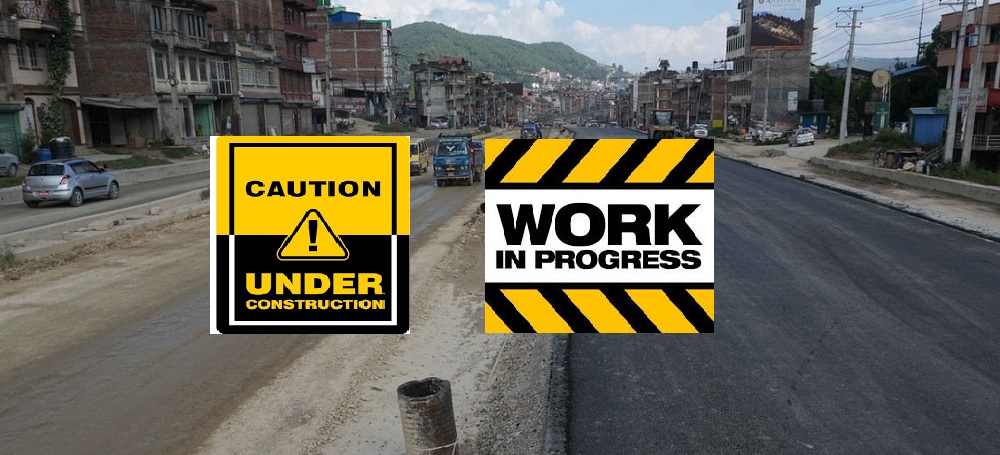
Himal Hub / A supply shock tied to escalating tensions between the United States and Iran has triggered a nationwide shortage of bitumen, paralysing asphalt works across Nepal at the height of the construction season and derailing progress on several flagship road projects.
Officials warn the disruption has struck at the heart of national pride and strategic infrastructure schemes, casting serious doubt on whether annual road surfacing targets can be met. While a handful of projects continue limited operations using residual stock, most have suspended asphalt works entirely.
“There is a shortage of bitumen in the market, and construction material costs have also surged,” said Bijay Jaisi, Director General of the Department of Roads. “This has had a sweeping impact nationwide, and discussions are under way to identify an urgent solution.”
Among the hardest hit are landmark initiatives such as the Mid-Hill Highway, Postal (Hulaki) Highway, Koshi Corridor, Kaligandaki Corridor, Karnali Corridor, and the Kathmandu-Tarai Expressway. Asphalt operations have also stalled on major stretches including the Madan Bhandari Highway and the critical Nagdhunga–Mugling road section.
The impact is particularly stark along the heavily trafficked Nagdhunga–Mugling corridor, which handles more than 12,000 vehicles daily. Asphalt works have come to a standstill after existing bitumen stocks were exhausted, leaving portions of the 94.66-kilometre upgrade incomplete despite nearing final stages in several sections.
Project officials report that in the Nagdhunga–Naubise stretch, preparations for the final asphalt layer were abruptly halted, with only six kilometres completed before supplies ran dry. Elsewhere, stripped road surfaces lie exposed, raising safety concerns as the monsoon season approaches.
Approximately 5,000 tonnes of bitumen are urgently required to resume work, according to project authorities. Progress has been further complicated by local protests delaying the extraction of construction materials, despite environmental clearance.
The crisis extends well beyond a single project. The Koshi Corridor remains less than half complete despite repeated deadline extensions, while the Kaligandaki Corridor has crossed 80 percent but now faces delays. The Karnali Corridor lags even further behind, with barely one-fifth of the work completed.
Ambitious long-term projects are also faltering. The Mid-Hill Highway, nearly two decades in the making, has achieved just over 80 percent completion, with this year’s surfacing targets falling far short. Similarly, the Postal Highway—designed to connect the Tarai belt—faces mounting delays, with officials conceding that annual targets may not be met without immediate supply improvements.
Even projects that had shown steady progress, such as the Madan Bhandari Highway, are now losing momentum. Meanwhile, the Kathmandu-Tarai Expressway, a high-priority national project being executed by the Nepali Army, has also seen its pace slow due to material shortages and escalating costs.
Road schemes backed by international partners have not been spared. Projects under the Asian Development Bank, including key expansion programmes, are experiencing similar setbacks as rising fuel prices compound supply constraints.
Contractors say the dual pressure of bitumen scarcity and soaring petroleum costs has forced them to scale back operations nationwide. With the monsoon imminent, officials warn that unfinished roadworks could heighten the risk of landslides, disrupt traffic, and further push back already strained timelines unless supply chains stabilise swiftly.